
Why home maintenance in Dubai costs what it costs. The AED 190/hour breakdown, the Fix-it-Twice cycle, and the math behind why “cheap” usually means twice.
In a hurry? The bottom line:
- The market rate for properly-done residential maintenance in Dubai is AED 250–320 for a standard small job — labour, parts, and warranty included. Anything well below that is usually cutting corners; anything well above is a brand premium.
- Our standard rate is AED 190 per hour for labour, plus parts. Inspection is free. Cheap quotes typically cost more in the end because of redo work — what we call the Fix-it-Twice cycle.
- An AMC isn’t really about saving money. It’s about not having to negotiate, search, or worry every time something breaks — particularly at 11pm in July. Worth it for households where peace of mind has real value; not necessary for light users with flexible schedules.
Here’s a scene from this March. A villa owner in Al Furjan messaged us about a persistent bad smell coming from his master bathroom floor drain. He’d used us before — quick plumbing job at the same villa a few weeks earlier. He’d paid happily and even asked for the technician’s name to give him direct feedback (“he was very good”). The kind of repeat customer maintenance companies in Dubai dream about.
This time we quoted our standard rate: AED 190 per hour.
His reply: “It was 110 last time.”
It hadn’t been. It had been AED 150. We told him that.
“Ok so why can’t it be the same this time?”
That’s the conversation most Dubai maintenance companies don’t bother to have — it’s easier to either lose the job or quietly drop the price and absorb the margin. So instead, we’re going to have it properly, in writing, once. This is why an hour of our work costs what it costs, why prices change, and how to tell — when you’re sitting in front of three quotes for the same job — which one is the fair one.
The AED 190/hour rate, broken down
Our standard labour rate is AED 190 per hour, Saturday through Thursday, between 9am and 6pm. Outside those hours — Friday, evenings, UAE holidays — it’s higher. Every quote is built on that number plus parts.
That AED 190 isn’t going into a technician’s pocket. Here’s roughly how an hour of labour breaks down once you account for everything that has to happen to get a uniformed, insured, trained two-person team — in branded vans, with proper ID — to your door at the time you asked:
| Where AED 190/hour goes (per visit, 2-tech team) | Cost |
|---|---|
| Technician team on-site (2 techs, working hour) | AED 53 |
| Technician travel + prep (between jobs) | AED 17 |
| Vehicle, fuel, Salik, parking | AED 22 |
| Customer acquisition + dispatch | AED 25 |
| Backend office (JLT — coordination, inventory, admin) | AED 60 |
| Insurance, tools, warranty buffer | AED 12 |
| Subtotal — what it costs us per hour | AED 189 |
| Margin | AED 1 |
| Total billed | AED 190 |
Notice what’s missing from that table: a meaningful margin line. The AED 1 in the second-to-last row isn’t a typo — adhoc labour at AED 190 per hour is, today, essentially break-even for us. We don’t make our living on hourly visits. We make it on Annual Maintenance Contracts and on AC servicing, where the unit economics work differently. Adhoc work covers its own costs and earns the trust that turns customers into AMC clients later. That’s why we don’t feel any pressure to inflate hourly quotes or pad invoices — we’ve already priced the hour at what it costs.
One thing worth naming: the parts that go with most jobs do carry a margin. Across a typical visit, that adds roughly AED 20 per hour on top of the labour break-even. So a more accurate way to say it is that AED 190/hour is the price of an hour of labour delivered properly, and the parts margin is what keeps the lights on. The AMC business is still where Fixo Felix actually scales.
Which brings us back to the conversation that opened this post. When we launched Fixo Felix, our rate was AED 150 per hour. That number worked when the team was small, the marketing budget was a Google account and a hope, and there wasn’t yet a 90-day workmanship warranty to honour out of our own pocket. As we built out the company — the JLT office, the trained technicians, the warranty buffer, the dispatch team, the branded vans and uniforms that show up at your door — AED 150 stopped covering the cost.
AED 190 is the real number for delivering this kind of work at this scale today. As costs rise — wages, insurance, fuel, parts — we’ll need to adjust periodically. As we grow and add teams, the JLT backend cost-per-hour pressures downwards, which offsets some of the increases. The net effect: we expect to move to somewhere in the AED 210–240 range over the next 6–12 months, with future changes likely being incremental rather than dramatic. We’ll announce any new rate on our homepage at least 30 days before it takes effect, so AMC customers and adhoc customers both get fair notice.
The “I did it cheaper already” problem
Customers tell us this all the time. A few weeks after we quote, the message comes back: “No thanks, I did it cheaper already.” Sometimes the work was fine. Often it wasn’t.
We’ve been near these prices ourselves — AED 150/hr was our launch rate, and we know what it does and doesn’t cover. It gets you in the door. It doesn’t get you a return visit when something fails three weeks later, because there’s no margin left in the price to send a technician back. The cheaper quotes you see in Dubai are usually one of two things: a company at that earlier stage, or a company that was never going to support the work afterwards in the first place.
When someone quotes you significantly under the market rate for a real job, one of three things is happening:
- The quote is for labour only, and materials will be added at the end — usually at a markup you’ll notice but not know how to argue with.
- The technician is unlicensed and uninsured, working out of a borrowed van. If he damages your pipework, your building, or himself on your property, you have no recourse. Your home insurance won’t cover it either — most policies require work to be done by a licensed contractor.
- The quote is real, the work gets done, and it fails within a few months because corners were cut on prep, materials, or both. You pay again — either to the same person who now wants more money to fix what he did, or to someone like us.
The Fix-it-Twice cycle. The third scenario is the one that quietly drains Dubai homeowners financially. Paying AED 150 twice in six months costs you AED 300 plus two wasted afternoons. Paying AED 280 once costs you AED 280 and a problem that stops being your problem. We call this the Fix-it-Twice cycle, and breaking it is roughly the whole reason Fixo Felix exists.
None of this is an argument that expensive is always better. There are maintenance companies in Dubai charging AED 400 for the same tap job we’d do for AED 280, with the same materials, by the same kind of technician — and the difference, almost always, is the size of their backend and the size of their margin. The market rate for work done properly, with a warranty you can actually invoke, is roughly AED 250–320 for a standard small job in April 2026. Anything much below that is a corner-cutting signal. Anything much above is backend cost or brand premium that you may or may not value.
Hourly rate vs flat price: when each makes sense
You’ll notice we quote some things hourly and some things flat. That’s deliberate.
Flat price is for services with predictable scope and a standardised checklist — AC servicing (AED 225 per unit minor, AED 585 deep clean) and painting (quoted by room or sqm with written specification). Same checklist every time, same price every time. If our technician finishes the AC service in 45 minutes instead of 60, you don’t get billed extra. If it takes 90 minutes because the drain line was unusually clogged, you also don’t get billed extra. We took the timing risk, not you.
Hourly is for everything else — TV mounting, tap and fixture replacement, lock repairs, hanging things, furniture assembly, plumbing leaks where the source isn’t yet visible, electrical troubleshooting. The reason: the work varies enormously job to job. Mounting a 32″ TV on a drywall partition is 30 minutes; mounting a 75″ on a marble feature wall with hidden cable runs is two hours. If we flat-priced these, we’d have to pad the quote enough to cover worst-case, which means you’d routinely overpay on the easy jobs.
For any hourly job, we’ll tell you the rough time estimate before we start, and we’ll let you know if anything on site changes that estimate before we exceed it.
One useful thing to know: an hour is a unit of time, not a unit of one task only. If our technician finishes your main job in 40 minutes and you have a couple of small things you’d like done with the rest of the hour — tighten a loose hinge, swap a few lightbulbs, hang a picture, secure a wobbly cabinet — we’ll do them within the same hour at no extra charge, as long as no additional materials are needed.
How we charge for parts
Parts are charged separately on top of labour. We mark them up — every maintenance company does, and any company telling you they charge “supplier cost only” is either lying or going out of business. The principle is straightforward, and we’d rather explain it than dodge the question.
Three things factor in. The cost of getting it to you — we keep a stocked van so the technician usually has the part on him rather than driving back to a supplier and billing you for the round-trip. The supplier’s warranty (or lack of it) — some small consumables come from suppliers who won’t take it back if it fails in six months. When that happens, we replace it for you anyway, free, because the labour we did to install it is under our 90-day workmanship warranty. The markup on those items is higher precisely because we’re self-insuring the part on your behalf. The size of the item — bigger items naturally carry smaller percentage markups; smaller items carry higher percentage markups but the absolute number stays small either way. This is how every retail and trade business in the world prices small consumables.
Parts policy in practice. Last December a customer messaged us about a table lamp not working — possibly the wiring, possibly the G9 bulb sockets. We told her, before the visit: “If you think it could be a socket problem we can bring the inventory in case. If our technicians diagnose the problem and it is not a socket problem, we will not charge you for the G9.” That’s how it should work. You pay for what gets used, not for what comes in the van.
What you should care about isn’t the percentage. It’s the absolute number on your invoice. Ask yourself “what would this cost at Ace or Speedex?” If our number is in the same ballpark as the retail price for a comparable part, you’re being treated fairly. If a meaningful item is wildly out of line with retail, that’s the moment to ask us directly. For larger or unusual parts — a new water heater, a replacement compressor, a specialty fixture — we always send you the price in writing before we order it. No surprises at invoice time.
Back to Nick’s bathroom
So what did the AED 190 conversation with our Al Furjan customer end with?
We told him: AED 150 was a launch rate from when we were getting started. AED 190 was what the work costs us to deliver now. We offered him a returning-customer rate of AED 175 per hour — splitting the difference because he’d been with us since the early days. He accepted, with one note: “This will be the test to determine if I can take a wider contract with you.”
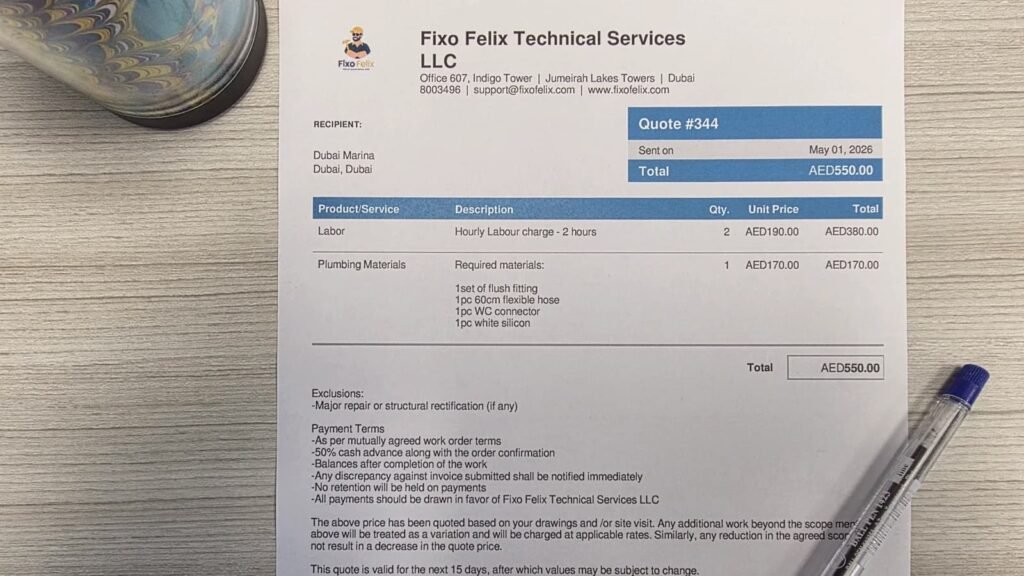
The team came back the next morning. The smell turned out to be the WC connector, but there was a second issue — the floor outlet hole wasn’t sitting flat, meaning even with a fresh connector the seal was leaking. The technician applied silicon around the outlet, reinstalled the WC, and came back the next day to verify the silicon had cured. AED 450 final, all in. That covered the diagnostic time, the actual repair, the return visit, and a 90-day workmanship warranty on the whole thing.
Nick’s AED 450 isn’t the expensive option. It’s the option where the smell stays gone the first time.
The AMC question
One thing we’ve noticed from looking at our customer history: roughly 8 in 10 customers who finish a first job with us come back for another within a few months. That’s not us being uniquely great. That’s Dubai homes just having a lot of things that need attention — AC drains, tap cartridges, door hinges, ceiling stains, balcony grout. Once you find a maintenance team that actually shows up and does the work properly, you stop calling around. Nick, who said “this will be the test,” is one of those customers now.
So the real question isn’t “should I get an AMC to save money?” It’s what an AMC actually buys you, and whether that’s something you value.
An AMC is closer to insurance than a discount package. Like home insurance, you’re not buying it because you expect to come out ahead in any given year — you’re buying it because you don’t want to be the person at 11pm on a Friday in July, with a kitchen leak spreading and the AC out, opening Google to find a plumber you’ve never used before, asking strangers what’s a fair quote, and hoping whoever turns up isn’t going to disappear after collecting payment.
What you’re actually buying with an AMC:
- One number to call, no negotiation each time. Whatever breaks, you message the same number. Same team, same standards, no fresh quote anxiety.
- 24/7 emergency response with labour included. Burst pipe at 11pm? Covered. AC compressor failure in July? Covered. You pay only for parts. The 120-minute SLA on Silver (90-minute on Gold and Platinum) means someone is on the way within a defined window — guaranteed in writing, not “we’ll try.”
- AC servicing handled without you remembering. Two services per AC unit per year on Silver, three on Gold, four on Platinum. We schedule, we remind, we show up.
- Plumbing and electrical inspections built in. Annual on Silver, biannual on Gold, quarterly on Platinum. Small problems caught before they become emergencies.
- Stronger parts protections. AMC clients get written approval over any part costing AED 300 or more before we order it.
None of that is about saving money on the line items. All of it is about removing a category of decisions from your week — particularly the decisions you’d otherwise be making at the worst possible moment.
For households where the cost of thinking about home maintenance is high — landlords managing properties from abroad, two-job couples, anyone with young kids — an AMC is the better deal even when it’s the more expensive one on paper. For light users with flexible schedules, adhoc is fine. We’d rather you stay adhoc and happy than sign you up to something that doesn’t fit.
Got a quote you want sanity-checked? WhatsApp us on +971 800 3496 with the quote and a photo of what needs fixing. We’ll tell you whether it’s fair — even when the answer is “go ahead with them.”
Pricing and rates referenced in this post are current as of April 2026 and reviewed periodically. Rates in effect at the time of booking will apply. Customer name in the opening scene has been changed; details are otherwise drawn from a real WhatsApp exchange.