
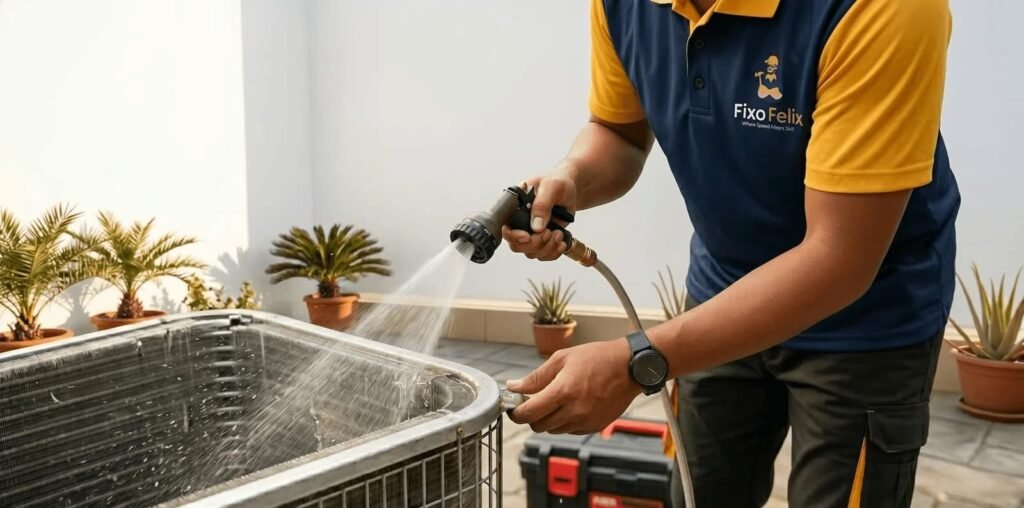
Why does preventive maintenance (PPM) pay for itself in Dubai? Because the climate compounds small problems faster than anywhere else. The failure modes, the costs, and the cadence that works.
In a hurry? The bottom line:
- Dubai’s climate makes home systems fail faster. With eight months of cooling demand, outdoor condensers sitting in 50°C+ ambient, and humidity working through every airflow path, the maintenance intervals that suit a milder climate are too long here.
- Reactive maintenance fails three ways. You pay emergency-window prices when something breaks, you miss the cheap-fix window that came months earlier, and your DEWA bill is up the whole time the system is degrading.
- Most failures are loud before they’re catastrophic. A worn capacitor, low gas pressure, a dirty coil: all small catches on a PPM invoice, but multi-thousand-dirham emergencies if left to compound.
- The cheapest version of this is a pre-summer service. At AED 225 per AC unit for a minor service, the math compounds in your favour across years.
A landlord messaged us at the end of March about damp walls in his Damac Hills 1 villa. He’d been overseas for months, and the photos his house staff had sent over were unsettling enough to prompt a call. Three of them, then this:
‘It’s not rain damage, it’s been getting worse over the last few months’
By the time the photos arrived, both bathrooms upstairs were showing moisture, the two bedrooms next to them looked the same, and the living room ceiling had a separate leak that the house staff had traced back to a balcony drain. He’d been hoping the whole thing would resolve itself.
It doesn’t, and in Dubai it usually does the opposite. What’s specific to this place isn’t that homes fail — homes fail everywhere. It’s that the climate compounds the failures faster, and reactive maintenance ends up costing more than people realise.
Why reactive maintenance fails in Dubai
“I’ll just call someone when something breaks” is a reasonable instinct, and in a milder climate it often works out fine. In Dubai it doesn’t, for three reasons that show up reliably across the homes we visit.
You pay emergency-window prices.
It’s July, the AC is dead, the apartment has climbed to 38°C inside by mid-afternoon, and you have no leverage. Whatever’s available, whoever can come today, whatever the part costs sourced same-day instead of ordered ahead: that’s the price you end up paying.
The same job in March is markedly cheaper, because demand is lower and contractors aren’t working through a queue of summer emergencies. The cost isn’t really about the work; it’s about when you booked it.
You miss the cheap-fix window.
Most systems give you warning before they fail catastrophically. A capacitor showing thermal wear will run hot for weeks before it gives out, a drain about to back up will drain slowly long before it stops, and a water heater anode nearing the end of its life will leave rust traces in the hot supply.
These signs sit in the system for weeks or months ahead of the real failure, and they’re exactly the kind of thing a routine visit is looking for. Catching any of them is a small line item on the invoice. Missing them is the multi-thousand-dirham repair, plus duress pricing on top because the discovery happens at the worst possible moment.
Your DEWA bill is up the whole time.
Fouled coils and clogged filters don’t stop your AC working; they make it work harder. Energy authorities including the US Department of Energy put the loss from a clogged filter alone at roughly 5 to 15% of consumption, and coil fouling pushes it further.
The losses also stack. A slow refrigerant leak, a worn fan motor, a loose contactor dropping voltage to the compressor, a thermostat that’s drifted out of calibration: each adds to the running cost, and when two or three are present at once you’re well past 15% on top of normal consumption.
In Dubai, where cooling is most of your DEWA bill for half the year, that’s real money, and the system is wearing faster the whole time you’re paying it.
What we catch on a PPM visit, and what it costs if we don’t
PPM stands for planned preventive maintenance. On the AC side it’s essentially the minor service: cleaning filters, flushing drains, inspecting each unit. On the plumbing and electrical side it’s mostly inspection, cleaning, and tightening of drains, valves, breakers, sockets, and water heaters, before any of them fails.
Concretely, here’s what those visits look for, and what each thing costs caught early versus missed.
| System Component | Caught on PPM (The Cheap Fix) | If Missed (The Dubai Emergency) |
|---|---|---|
| AC Drain Lines & Trays | 15-minute flush included in your minor service. | Water leaking into the apartment below. Structural repairs, ceiling damage, and Owners’ Association headaches. |
| Capacitors & Contactors | Quick part-and-labour swap. A minor line item. | Component fails at 45°C, destroying the compressor. Several thousand dirhams and a week without cooling. |
| Loose Electrical Terminals | Tightened during the visit at no extra charge. | Random circuit trips that eventually destroy the breaker. Emergency electrician callout plus parts. |
| Water Heater Seals & NRV | Inspection of anode and non-return valve; cheap preventative replacement. | Valve fails, water backflows, pipework bursts. Flooded bathroom, and a ruined ceiling for whoever lives underneath you. |
| Roof Tanks & Pumps (villas) | Tank seal, pump operation and pressure checked on every villa-scope visit. Worn parts replaced cheaply. | Tank seal failure can drip water into rooms beneath. Pump failure means no water in the villa until a same-day replacement is sourced. |
| Roof Drains (villas) | Flushed and checked to make sure water flows properly down to ground level. | The opening scene of this post. Heavy rain finds blocked drains, water seeps through cement into the villa, damaging ceilings, ruining wooden flooring, soaking furniture. |
What this comes down to. Each item above is a small, inexpensive component that costs little to inspect or replace early, and a lot to deal with once it’s failed. PPM isn’t magic; it’s just being in the room before the failure happens, instead of after.
How often, then?
A reasonable question, and the answer depends mostly on what kind of property you’re in.
- Apartments: AC service twice a year, plumbing & electrical PPM once. The AC service works best once before summer and once mid-summer if the system is being worked hard, with the plumbing and electrical PPM bundled into the pre-summer visit: one technician, one report, one slot.
- Villas: AC service three times a year, plumbing & electrical PPM twice. Villas carry more: more square metres, more AC units, water tanks and pumps sitting under summer sun, roof drains that need to be clear before winter rain. The extra cadence reflects the load.
Newer properties in their first year or two can usually get by on less than this, because most major systems are still under warranty and haven’t started showing the wear that older homes accumulate. Properties past the five-year mark tend to need the full schedule. If you’re somewhere in between, the pre-summer service is the non-negotiable floor.
When preventive maintenance doesn’t pay for itself
The same caveat we apply to the AMC posts. Preventive maintenance isn’t right for every home, and there are three scenarios where the math doesn’t run, worth checking yourself against before you book anything.
- You’re in year one or two of a new property under developer warranty. Most major systems are still covered by the warranty that came with the handover, and a full preventive programme tends to be redundant until that warranty expires.
- Studio or one-bedroom, one AC, light usage. A focused AC service before summer is worth it. A full home PPM programme is over-spec for a property this size and this lightly worked.
- Your building service charge already includes labour-inclusive PPM. Common in newer JLT, Marina, Downtown, and Business Bay towers. It’s worth checking with the building manager once a year. If it’s already covered as part of what you pay, you don’t need us on top of it.
Want a starting point?
For most homes, the cheapest version of preventive maintenance is a single pre-summer service: an AC minor service plus a written report covering the rest of the home, telling you what’s fine, what to keep an eye on, and what needs attention now.
For the next six weeks we’re running a pre-summer bundle priced for exactly this situation. Compact homes get the Home PPM free with their AC service, and family and larger homes get tiered rates that come in well below the standard pricing.
If a year-round commitment makes more sense for your situation, the AMC primer covers what an annual contract actually is, the starting-prices guide has the line-by-line math, and the decision-triggers post walks through when an AMC starts to make sense.
Pre-summer bundle through 1 July 2026: one visit, one technician, one written report. AC minor service plus a full plumbing & electrical check; apartments get the PPM portion free, villas get tiered bundle rates.
WhatsApp us on +971 800 3496 with the word “AC”, your property type, and your AC count, and we’ll send a confirmed slot within the hour.
Pricing references in this post (AED 190/hour labour, AED 225/unit AC minor service, bundle rates valid through 1 July 2026) reflect our standard rates as of May 2026 and are reviewed periodically. Efficiency figures cited are general AC industry estimates anchored to US Department of Energy guidance; Dubai-specific impact varies by system, age, and operating conditions. Details in the opening scene are drawn from a real WhatsApp exchange; the customer is not identified.