
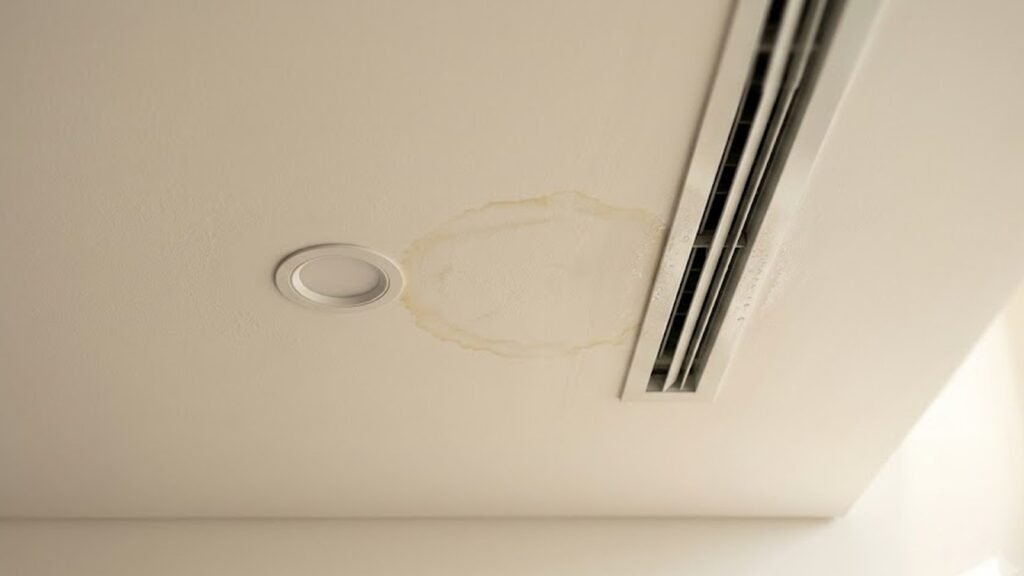
“It’s the ceiling of my bathroom, there’s a leak above the bathtub. Is it the water heater? Or from the apartment above? The building technician told me it’s the cold water pipe of my unit.” That is roughly how a water leak gets reported: three different guesses in one breath, and every one of them plausible.
That is the difficulty with a water leak. By the time you can see it, the water has usually travelled, and the stain on your ceiling is rarely sitting directly under the thing that is actually leaking.
The good news is that you can usually narrow down what kind of leak it is yourself, before anyone visits, just from where it shows and how it behaves. That tells you which trade you need, how urgent it is, and sometimes that it is not your leak to fix at all.
Bottom line: Where a leak shows is your best clue to what is causing it. A ceiling stain in a Dubai tower is most often an AC drain line above, sometimes the water heater or a chilled-water pipe, sometimes the flat above. A wall patch is often summer condensation on a cold-water pipe. A damp floor usually means water tracking through from a bathroom behind it. Knowing which narrows down who to call, and whether it is even your problem.
- Ceiling stain or drip: most often the AC drain line above, which clogs with dust over time. Then the water heater, or a chilled-water pipe whose insulation has failed. Sometimes the apartment above.
- Wall stain or damp patch: in summer, most often condensation building on a cold-water pipe. Can also be a leak tracking through from a bathroom on the other side of the wall.
- Floor or skirting damp: less common, and usually water leaking through from a bathroom behind the wall, showing as dampness and paint peeling.
- Is it even yours? A leak from inside your apartment is yours to maintain. A leak from the flat above, or from pipework outside your unit, is not.
Start with where the water is showing
A leak almost never announces its source. Water finds the easiest path down and sideways, so it can travel along a beam or a pipe and surface a long way from where it began. That is why guessing from the stain alone rarely works, and why the mark is a starting point rather than the answer.
What the location does tell you is which family of causes to look at first. A ceiling behaves differently from a wall, and a wall differently from a floor. Taking them one at a time is how a technician narrows it down, and it is how you can too.
A water leak showing on the ceiling
This is the most common one we are called to, and in a Dubai tower it usually comes from one of a few places. Our team’s first job is to work out which, and that often means opening the ceiling at the stain to see the source directly.
By a clear margin, the most frequent cause is the air conditioning: the drain tray or drain line above the ceiling overflowing or leaking. The reason it tops the list is simple.
That drain line accumulates dust over time, which is what clogs it and pushes water back out, so it is the part most prone to leaking and the one most worth keeping clean.
After the AC comes the water heater sitting in the ceiling void, though as standard it is not the more likely culprit. In many Dubai buildings the insulated chilled-water pipes that feed the AC also run through the ceiling, and when that insulation is damaged the pipe sweats and drips.
And in some cases the water is not from your ceiling at all, but from the apartment above, which is its own question covered further down.
A technician tells these apart once the ceiling is open, because an active leak is visible at its source: a wet drain line, a weeping heater connection, or a stretch of pipe where the insulation has failed and water is forming along it.
Is the drip active, or is the stain old?
One quick read tells you a lot. Touch the edge of the stain: if it is wet and spreading, the leak is live and worth acting on quickly. If it is dry and has not grown, you may be looking at the mark a past leak left rather than an active one.
A water leak showing on a wall
A damp patch on a wall, especially one that appears or worsens through summer, is most often not a leak at all in the usual sense. It is condensation forming on a cold-water pipe running inside the wall.
When it is hot outside, the cold pipe draws moisture out of the warm air around it, the way a cold glass sweats on a summer day. In a building with open service areas that effect is stronger, and the water soaks into the wall as a damp patch. It eases off in cooler months and returns with the heat.
Less often, a wall patch is water tracking through from a bathroom on the other side, which is the same mechanism behind a damp floor and is covered just below.
One thing the wall does not tell you on its own is whose pipe it is. A pipe inside your wall is yours, but if it runs outside your unit, that sits with the building.
A water leak showing on the floor or skirting
This one is less common, but when a floor or the skirting goes damp, it usually is not the floor itself. It is water leaking from behind the wall, most often from pipework inside a bathroom, soaking through to the other side and showing up as dampness and paint peeling near the bottom of the wall.
So a damp skirting in a bedroom that backs onto a bathroom is a strong hint to look at the bathroom plumbing behind it, not at the floor in front of you.
When is a water leak an emergency?
Most household leaks are not emergencies. They are the small, contained kind: a dripping water heater, a leaking WC, a wash basin, a mixer, or a shower. These are worth booking in promptly, but they are not a middle-of-the-night call.
A leak becomes urgent when it is doing real damage fast, or when it threatens your water supply altogether. The clearest cases are a complete loss of water to the whole property, low pressure across the entire home heading toward no water at all, a water tank overflowing, or a blockage that floods the inside of the home.
In Dubai communities especially, an overflow that sends water out toward the road has to be stopped quickly, so that is treated as urgent.
| Treat as urgent | Book in promptly |
|---|---|
| Total loss of water to the whole property | A dripping or leaking water heater |
| Low pressure across the whole property, heading toward no water | A leaking WC, wash basin, mixer or shower |
| A water tank overflowing | Low pressure or a slow drip at a single fixture |
| A blockage flooding the inside of the home | A slow, contained leak at one point |
What you can safely check yourself
Before you call anyone, there are a few safe checks that help you and your technician both.
First, read the stain: is it wet or already dry, and is it growing? That one observation tells a technician whether the leak is still live.
Second, if you can safely reach the ceiling and it is an accessible panel, you can open it to see where the water is coming from. If the leak is at the water heater, there is a valve on the heater you can close to shut off its water and stop further damage until the technician arrives.
And one thing not to do: do not poke around a wet patch near a ceiling light or an AC unit, and do not open a panel where water sits against an electrical fitting. Water and live electrics are the one place taking a look stops being safe. If the wet area is near anything electrical, leave it and call.
Will they have to cut the ceiling open?
This is a question we are often asked, and the answer is: not always.
Opening the ceiling is only done where the source cannot be reached or confirmed any other way. In some cases the leak is found and fixed without cutting at all, as when a water heater is the culprit and can be reached directly.
Where a panel does have to come down to reach a pipe or a drain line, it is opened at the smallest point needed, not torn out wholesale.
Whose water leak is it, anyway?
This is the part worth getting right before money changes hands, because not every leak is yours to fix.
The simple rule is location. Anything inside your apartment is yours to maintain, including the pipes and the chilled-water lines that run within your own walls and ceiling. If a leak traces to a pipe outside your unit, in the building’s shared system, that is not yours to handle.
The clearest case is a leak coming from the apartment above. That water is coming through your ceiling, but the source belongs to the unit above, so fixing it is that resident’s responsibility, not yours. The only complication is access, since the work often has to be reached from your side, but the responsibility still sits upstairs.
What an AMC covers, and what is charged
If you hold a maintenance contract, the labour for all of this is included: the callout, the work to find the leak, and stopping it, across unlimited visits. What sits outside that is materials and building fabric.
Finding the leak and stopping it is covered labour. A replacement part, such as a length of pipe, a fitting or a valve, is a material, charged separately at our standard rate and always with your approval first.
The building-fabric side is a separate job: re-waterproofing, re-tiling, or opening up and making good a slab to reach concealed pipework are quoted as their own works, not routine cover.
And a leak that turns out to belong to the flat above, or to pipework outside your unit, is not something we would bill you to chase into someone else’s property. You can read the full picture in our guide to what a maintenance contract actually covers.
How to stop a leak starting in the first place
Since the most common ceiling leak traces back to an AC drain line clogged with dust, the prevention is the same routine that keeps the AC running well: have the drain line flushed and the system cleaned on a schedule rather than waiting for the day it backs up.
The two related symptoms are worth knowing too, an AC that leaks water inside and a bathroom that smells of drains, since both share roots with a leak you can see. We have written separately on why preventive maintenance pays for itself in Dubai if you want that side of it.
Frequently asked questions
How do I find where a water leak is coming from?
Start with where it shows. A ceiling stain in a Dubai tower is most often the AC drain line above, sometimes the water heater or a chilled-water pipe, sometimes the apartment above. A wall patch is often summer condensation on a cold-water pipe. A damp floor usually means water tracking through from a bathroom behind it. The mark is a clue to the cause, not proof, because water travels before it shows.
Why is there a water stain on my ceiling?
In most Dubai apartments the likeliest source is the air conditioning above the ceiling, specifically the drain line, which clogs with dust over time and pushes water back out. After that come the water heater and a chilled-water pipe whose insulation has failed and is sweating, and in some cases a leak from the apartment above. A technician confirms which by opening the ceiling at the stain and finding the source directly.
Is a water leak an emergency?
Usually not. Small contained leaks, a dripping water heater, a leaking WC, basin, mixer or shower, are worth booking in promptly but are not emergencies. It becomes urgent when it does fast damage or threatens your supply: a complete loss of water, low pressure across the whole property heading toward none, a tank overflowing, or a blockage flooding the home, which in a Dubai community needs stopping quickly before water reaches the road.
Can I check a water leak myself before calling?
You can safely do the simple checks: see whether the stain is wet or dry and whether it is growing, and if you can reach an accessible ceiling panel, look for the source. If it is the water heater, you can close its valve to limit damage. What you should not do is investigate a wet patch near a ceiling light, an AC unit, or any electrical fitting, since water and live electrics are not safe to handle.
The leak is from the apartment above. Is it my problem?
No. If the water is coming from the unit above yours, the source belongs to that apartment, so fixing it is that resident’s responsibility rather than yours, even though it is showing through your ceiling. The only practical wrinkle is that the repair often has to be accessed from your side. Anything inside your own apartment is yours to maintain; anything in the building’s shared pipework outside your unit is not.
Will the ceiling have to be cut open to fix a leak?
Not always. The ceiling is only opened where the source cannot be reached or confirmed any other way, and even then it is opened at the smallest point needed rather than torn out. Some leaks, such as a water heater that can be reached directly, are found and fixed without cutting at all. A technician will tell you what access the repair needs before doing it.
Not sure whether that stain is an AC drip, a sweating pipe, or something coming from next door? Tell us what you are seeing and where, and we will help you work out what it is, even if it turns out to be something you can sort yourself, or not your leak at all. Call us on 800 FIXO (3496) or message us on WhatsApp +971 800 3496.
The coverage and contract terms referenced in this post reflect our standard AMC contract and ad-hoc rates as of June 2026 and are reviewed periodically. The labour to find and stop a leak is covered callout work; spare parts and materials are charged separately on all tiers and quoted with your approval first, and building-fabric work such as re-waterproofing, re-tiling, or making good a slab is quoted as a separate job.
Details in the opening scene are drawn from a real WhatsApp exchange; the customer is not identified.