
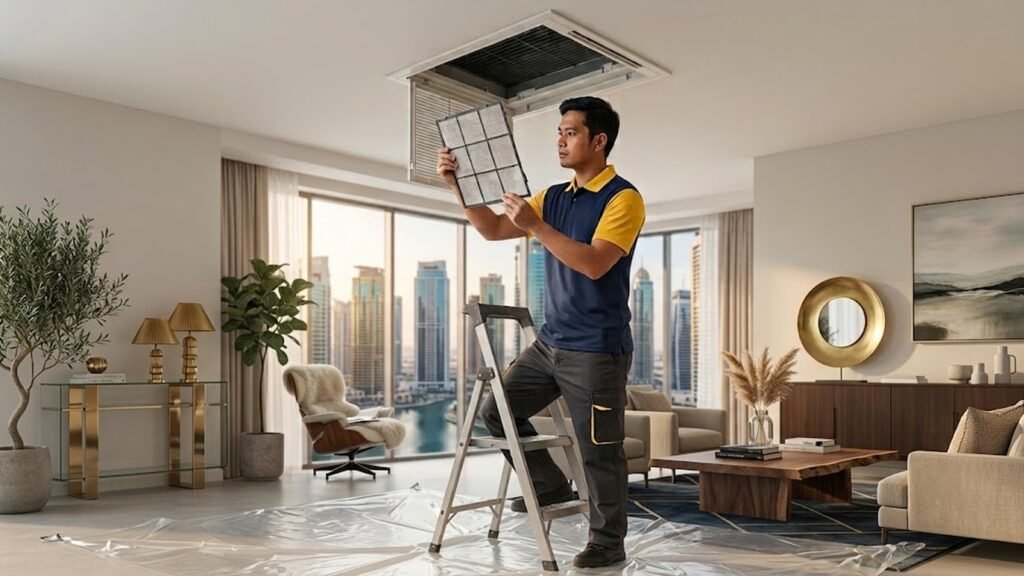
“I live in an Emaar high rise in downtown. I just want to do routine ac maintenance. Can you tell me what services you offer or recommend?” That is how a good number of our summer jobs begin: not with something broken, but with someone getting ahead of it before the heat arrives.
That instinct is the right one here. In Dubai, the gap between an AC that gets looked at before summer and one that gets ignored until it fails is the difference between a small job and a big bill.
The truth is there is only a little a resident can safely do without a technician, and most of the value is in knowing what to look for and what to leave alone. This checklist sorts the two.
Bottom line: Before peak summer, a few AC checks are safe to do yourself in a Dubai home, and several should be left to a technician. The ones that matter most cost nothing: clean an accessible filter, drop a drain tablet in the tray, set the thermostat right, and watch for a small water mark or an unusual noise. Catching those early keeps a cheap problem from becoming an expensive one.
- You can safely do: check and rinse an accessible filter, add a drain tablet to the tray, set the thermostat right, and notice and report early signs.
- Leave to a technician: flushing the drain line, coil cleaning, gas pressure, and anything electrical.
- The signs worth catching: a small water mark on the ceiling, and any unusual noise from the unit. Both get expensive if ignored.
- The one thing not to do: do not keep switching a non-cooling AC on and off. It is the most common way a repairable fault becomes a dead compressor.
Why pre-summer AC maintenance matters in Dubai
Through the cooler months, dust settles into the parts of an AC you do not see, and the drain line in particular slowly clogs. You may not notice while the system is barely working. Then summer arrives and the AC runs far harder than it has all year.
That is when a half-blocked drain line backs up, a tired fan motor gives out, and a coil thick with dust stops the unit cooling properly. The point of pre-summer maintenance is to clear all of that before the load hits, not after.
What you can safely check yourself
A few checks are genuinely safe for a resident, with one condition running through all of them: only do them if you can reach the unit safely. If you cannot, that is not a failure, it is just the point where you call.
The air filter, if you can reach it safely
In many homes the filter sits behind an access panel or a removable ceiling tile. If yours is reachable with a ladder, you can take the filter out, rinse it with water, and put it back. A clean filter is the most common fix for weak airflow.
Two cautions. Do not force it if the access is not safe, for example if the panel is directly above a bathtub or a WC where a slip would be serious. And when you rinse the filter, do not poke a hole in it, as a torn filter stops doing its job.
A drain tablet in the tray, if it is accessible
If you can reach the drain tray, you can place a drain tablet in it and let it work over time. It helps keep the line from clogging between services. What you should not do is try to flush the drain line yourself.
Flushing water through an uncontrolled drain line, with nothing to catch it, is how water ends up on the ceiling and leaves a stain. A technician does this with sheeting in place to catch the water. The tablet is the safe resident version; the flush is not.
The thermostat, before you assume the worst
Before deciding an AC is broken, check the thermostat is actually set to cool and to a sensible temperature. It sounds obvious, but a unit set to a high temperature, or to the wrong mode, can look exactly like a failure when nothing is wrong with it at all.
Notice the early signs, and report them
The most useful thing a resident can do is not a repair at all. It is noticing the small signs early and reporting them, because each one is cheaper to deal with now than later.
- An unusual noise. This is the one to act on quickly. A new or loud sound can mean a failing fan motor, and a failing motor left running can take the compressor with it, which is a far bigger repair.
- A musty smell. Usually moisture sitting in the unit and drying out. Worth mentioning at your next service rather than ignoring.
- Weak airflow. Most often a dirty filter you can clean yourself, sometimes a dust-clogged blower that a technician needs to clear.
The outdoor unit, by looking only
If you can safely reach where the outdoor unit sits, and there is a visible gap in its cover, you can glance to see whether the condenser coils look dusty. That is the limit of it. The covers are not yours to remove, and many homes have no safe access at all. If you cannot see it safely, leave it.
What a technician handles, and you should not
The rest of an AC service involves tools, electrical components, refrigerant, or controlled access, and is not resident work. This is the part a maintenance visit is actually for.
- Flushing the drain line properly, with sheeting in place to catch the water.
- Coil cleaning, from a light clean to a full chemical clean when the coil is heavily fouled.
- Gas pressure checks and any refrigerant work.
- Electrical components, the control board, fan motors, capacitors and contactors.
- The blower, which clogs with dust and chokes airflow in a way a filter rinse will not fix.
The one thing not to do
If your AC is not cooling, the most common and most costly mistake is to keep switching it off and on, hoping it catches. It is an understandable instinct. It is also the fastest way to turn a repairable fault into a major one.
Here is why. If the unit is not cooling because the fan motor has failed or the gas is gone, forcing it to run keeps the compressor working with nothing to cool. The compressor overworks, overheats, and can be damaged beyond repair. A fault that started as a fan motor job becomes a compressor replacement.
So if the AC stops cooling, the right move is the opposite of forcing it: turn it off and call. There are several things that need checking in order, the gas, the motor, the compressor, and that sequence is a technician’s job, not a switch to keep flicking.
And one electrical caution
Do not put water near the electrical parts of the unit. If water gets in and trips the breaker, do not try to dry the electrical components while the unit is live. Many people are unsure how to fully power an AC down, and drying live electrics is where a look stops being safe. If water and electrics meet, call.
Small signs, big bills: two worth catching early
Two of the signs above deserve their own word, because they are the ones that quietly turn into the most expensive repairs we attend.
A small water mark on the ceiling
A small drip or water mark from the AC is rarely just a small drip. It usually means the drain tray and drain line are already clogging. Left alone, that backs up and overflows across the ceiling.
At that point you are not only paying to clear the drain. A ceiling that fills with water gets heavy, stains, and can come down, taking furniture below it with it.
The early version of this is a drain clean. The ignored version is a drain clean plus a ceiling repair. If you see a mark, treat it as something to check now. We have written separately on how to trace where a water leak is coming from and what to do when your AC is leaking water inside.
An unusual noise
A new noise from an AC can mean a loose part, a worn fan belt, or a failing fan motor. The reason it is worth acting on fast is what comes next. If a motor is failing and the unit keeps running, the compressor keeps working against the fault and can overheat and fail too.
That is the difference between a fan motor repair and a compressor replacement, which can run several times the cost. A noise caught early is a small job. The same noise ignored through a hard summer is the most expensive AC repair there is.
Where an AC maintenance contract fits
Everything in the technician column is exactly what a maintenance contract schedules. Rather than remembering to book a pre-summer service, the visits are planned across the year, with the drain line, coil, electrical checks and the rest done on a schedule before summer rather than after a breakdown.
On our contracts the labour for all of this is included, across every tier, including unlimited emergency callouts. What is charged separately is spare parts and materials, always quoted with your approval first.
How often the planned visits happen depends on the tier, from twice a year per unit up to four times. You can read what a contract covers in our guide to what an AMC actually covers, and why preventive maintenance pays for itself in a Dubai summer.
Frequently asked questions
What should be on a pre-summer AC maintenance checklist?
A few things you can safely do yourself: clean an accessible filter, put a drain tablet in the tray if you can reach it, and check the thermostat is set correctly. The rest belongs to a technician, flushing the drain line, cleaning the coil, and checking gas pressure and electrical parts. The most useful resident habit is noticing early signs, a small water mark or an unusual noise, and reporting them.
Can I service my AC myself before summer?
Only partly, and only safely. You can clean a reachable filter, add a drain tablet, and set the thermostat right. You should not flush the drain line, touch gas, or open up electrical parts, and you should not attempt any check where the access is unsafe, such as a panel above a bathtub. A full service uses tools and access a resident does not have.
Why does my AC need maintenance before summer specifically?
Through the cooler months dust settles in and the drain line slowly clogs while the system is barely working. In summer the AC runs far harder, and that is when a half-blocked line backs up or a tired part fails. Clearing it beforehand means the system meets the heat clean rather than failing under load.
Is it bad to keep turning my AC off and on when it is not cooling?
Yes, it is the most common costly mistake. If the unit is not cooling because a motor has failed or the gas is gone, forcing it to run makes the compressor work with nothing to cool, which overheats and can destroy it. A fan motor fault becomes a compressor replacement. If your AC stops cooling, turn it off and call rather than restarting it repeatedly.
What does an unusual noise from my AC mean?
It can be a loose part, a worn fan belt, or a failing fan motor. It is worth acting on quickly because a failing motor left running can take the compressor with it, turning a small repair into a much larger one. If you hear a new or loud noise, it is better to have it checked early than to run it through a hard summer.
What is the difference between minor and major AC service?
A minor service is the routine checklist done at a planned visit: filter, drain line, drain tray, coil condition, electrical checks, thermostat and grill temperature. A major service is a deep chemical clean of the coil, done only when a technician finds the coil heavily fouled. The major clean is a separate, longer job and is not part of the routine visit.
Want your AC looked at before the heat really lands? Tell us your building and how many units you have, and we will tell you what a pre-summer service should cover, even the parts you can sort yourself. Call us on 800 FIXO (3496) or message us on WhatsApp +971 800 3496.
The coverage and contract terms referenced in this post reflect our standard AMC contract as of June 2026 and are reviewed periodically. Labour is included across all tiers; spare parts and materials are charged separately and quoted with your approval first.
Details in the opening scene are drawn from a real WhatsApp exchange; the customer is not identified.