
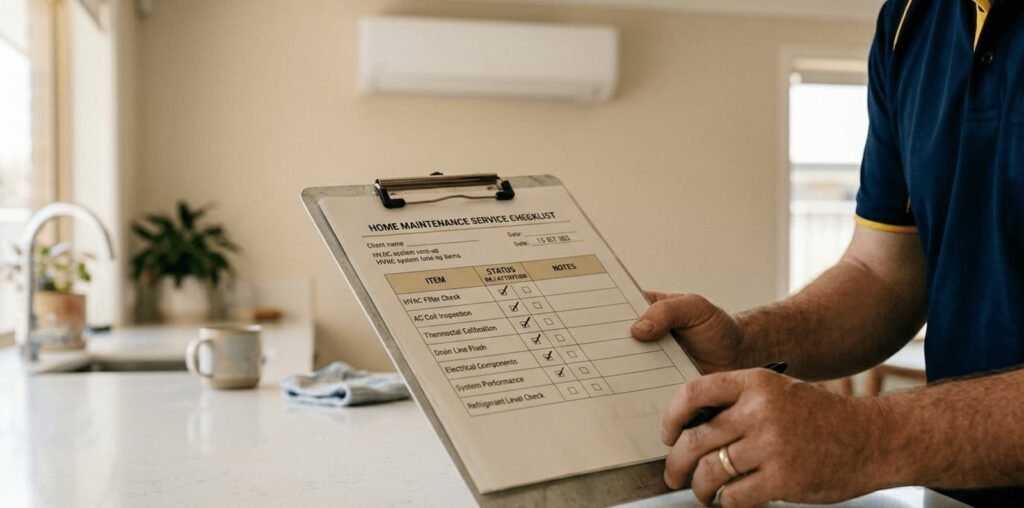
What does an AMC actually cover? Three kinds of work, in three different ways: knowing which is which tells you exactly what happens when you call, and what lands on the invoice.
In a hurry? The bottom line:
- An AMC covers three kinds of work, three different ways. Reactive callouts with labour included, scheduled visits on a calendar, and out-of-scope jobs at a discount. They aren’t the same kind of “covered.”
- Reactive callouts are the core, and they’re unlimited. Something breaks, you call, the labour is included, any hour of any day. What changes is the response time, depending on whether it’s an emergency.
- Emergency and non-emergency are defined, not guessed. Roughly: is the home unliveable, or is damage happening right now? If you’re unsure, you call and we place it for you.
- Where covered ends is a clean line. Labour on the covered trades is included. The physical parts, and any new work that adds rather than repairs, are billed separately at our standard rate.
A villa owner messaged us about a bad smell coming from his ducted AC. We talked through the inspection and the hourly rate, and then, before booking anything, he asked the question most people are turning over in their heads but don’t always say out loud:
“If the job requires you to bring materials, so you need another visit, will you charge me again?”
A few messages later, having sat with the adhoc maths for a moment, he asked the second one:
“You do service contract?”
What he was really asking, across both questions, is the thing nobody quite spells out when they sell you an AMC. When I’m on a contract and something happens, what’s actually covered? What comes free, and what still shows up on a bill?
It’s a fair question, and the answer is clearer than most providers make it sound. An AMC covers three different kinds of work, and it covers each of them in a different way. Once you can see the three, the whole thing stops being vague.
The first kind: reactive callouts
This is the part people underestimate before they own a contract, and the part they value most once they do. Something breaks, you call, a technician comes out and fixes it, and the labour is included. No per-visit charge, no hourly meter running while they work. Across all tiers, these callouts are unlimited.
That’s the engine of the contract. Not the scheduled servicing, not the discounts, but the simple fact that when something goes wrong you make one call and the labour to put it right is already paid for. Parts, if a repair needs them, are billed separately, and we’ll come back to exactly where that line sits later on.
What changes from one callout to the next isn’t whether it’s covered. It’s how fast we’re contracted to be there, and that depends on whether the problem is an emergency or not.
What counts as an emergency
An emergency is something that makes the home unliveable, or that’s actively causing damage while you wait. The contract sets a fast response clock for these: 120 minutes on Silver, 90 minutes on Gold and Platinum, around the clock, every day of the year.
| Emergency: immediate response | Non-emergency: same day |
|---|---|
| Total AC failure, or no cooling at all in summer heat. An active leak flooding a room, or no water to the whole property. Complete loss of power to the villa, or to a full floor. A burning smell, a spark, any sign of an electrical fire. Sewage backing up into the home, or a water tank overflowing into the community where it can draw fines. (90–120 min response, 24/7) | A single AC unit not cooling, or making a noise. A contained drip or low pressure at one fixture. A blocked drain that isn’t flooding. A few sockets out, or one circuit tripping. (Same-day response; 6 hr on Platinum) |
The dividing line is roughly that simple. Is the home unliveable, or is something getting damaged right now? That’s an emergency. Is it genuinely annoying but able to wait until later today? That’s a non-emergency, and it still gets a same-day response, just not the 90-minute clock.
And you don’t have to make that call yourself. Where the line between emergency and non-emergency sits is something we’ve thought carefully about and set out clearly, so it’s applied consistently and fairly rather than decided on the spot. You call, you tell us what’s happening, and we place it for you against that same standard everyone gets. Flag anything you’re unsure about; that’s exactly what the call is for.
The second kind: the scheduled visits (your PPM)
The reactive callouts handle things once they’ve gone wrong. The scheduled visits are the half of the contract built to stop them going wrong in the first place.
These are your planned preventive maintenance visits, the PPM you’ll see named in the contract and on your service reports. AC servicing on a set cadence through the year, plus plumbing and electrical inspections that clean, check, and tighten before anything fails.
They happen on a calendar, so they get done whether or not you remember to book them, which on adhoc is usually the thing that quietly never happens.
We’ve written separately on why preventive maintenance pays for itself in Dubai and what a visit actually covers, so we won’t repeat it here. For the purposes of what’s covered: the labour and the visit itself are included in your fee. It’s covered work, on a schedule, included.
The third kind: covered at a discount, not for free
This is the one most worth understanding before you sign, because it’s where “covered” quietly changes meaning. Some work isn’t included in the fee at all. Instead it’s offered at a discounted rate to contract clients. Covered, in the sense that you get a better price, but not free.
Two things sit here. The first is out-of-scope handyman work: furniture assembly, picture hanging, larger painting jobs, the general tasks outside the three core trades. These run at the standard hourly rate with your tier discount applied, 10 to 20% depending on the contract.
The second is the major AC service, the deep chemical clean a unit needs when it’s heavily fouled. It isn’t a free scheduled inclusion. Your contract gets you a discount on it, scaled by tier, but the work itself is quoted and approved separately when a technician identifies that a unit needs it.
The full list of what sits outside the fee, from parts through to structural work, is laid out in the cost guide. The point for here is just the principle: this third bucket is discounted, not included, and it’s worth knowing which bucket a given job falls into before you assume it’s free.
Where what an AMC covers actually ends
Here’s the clean line, the one the villa owner at the top was really asking for. On the covered trades, the labour is included: the technician’s time to come out and fix what’s broken doesn’t generate a separate bill, however many times you call.
What sits on the other side of the line is two things. The physical parts, which are billed separately at our standard rate, with anything above a small threshold needing your written approval before we order it.
And new work that adds rather than repairs: fitting a socket where there wasn’t one, running new pipework, installing something new. That’s an addition, not a repair, and additions are billed.
That’s the whole boundary. Labour to fix covered things, included. Parts and new additions, billed, never as a surprise. Once you hold those two sides in your head, you can predict exactly what any given callout will and won’t cost you.
Want to see it against your own home?
“Covered” isn’t a slogan, and it isn’t a single promise. It’s three specific mechanics: unlimited reactive labour, scheduled visits on a calendar, and discounted rates on everything else. The provider worth signing with is the one who can tell you which is which before you’ve paid, not after.
If you want to walk through what your home would actually draw on, that’s a short conversation rather than a sales pitch.
Not ready to commit to a year? Our pre-summer bundle, running through 1 July 2026, gets you an AC minor service plus a written report on the rest of the home, no contract attached. It’s the lowest-stakes way to see how we work. WhatsApp us on +971 800 3496 with the word “AC”, your property type, and your AC count, and we’ll send a confirmed slot within the hour.
Response times, tier discounts, and coverage terms in this post reflect our standard AMC contract as of May 2026 and are reviewed periodically. Emergency and non-emergency classifications, response windows, and part-approval thresholds are set out in full in the contract document. Pricing references (AED 190/hour labour, AED 225/unit AC minor service) reflect our standard rates as of May 2026. Details in the opening scene are drawn from a real WhatsApp exchange; the customer is not identified.